MMPP-001, also printed as MMPP 001, MMPP 01 and MMPP 1
IGNOU MBA Project (MMPP-001): Free Sample PDFs, Then the Method, Data and Results Your Report Needs
By BK Sahni, founder of Shri Chakradhar Publication Pvt. Ltd. | Updated
How this page was made: prepared from IGNOU's MMPP-001 Guidelines for Submission of Synopsis and Project Report (School of Management Studies, read in full), the Common Prospectus (July 2026, pp. 27, 32 and 131 to 140) and IGNOU's OPMS guidelines for the December 2026 Term-End Examination, all read in November 2026; drafted with AI assistance, every rule checked against those documents, experience notes from BK Sahni's desk, and published under his editorial responsibility.
MMPP-001 at a glance, then the evidence
IGNOU MBA Project means MMPP-001, an eight-credit project course for MBA, MBAFM, MBAHM, MBAMM, MBAOM, MBF and MBA (Online) learners. It runs in two stages: a synopsis sent to your Regional Director for approval, then a report of about 18,000 words. The weight sits on evidence: objectives matched to data, tools and statistics, a reliability and validity line for each tool, and tables with a full interpretation. Run the two free checks below, then take the sample files.
8 creditsMMPP-001 equals two courses but is registered as one, with no study material.
6 method itemsThe research methodology part of the synopsis must cover all six.
About 18,000 words50 to 60 double-spaced pages, appendices and exhibits excluded.
2 to 3 monthsTime the guidelines give for the written approval decision.
Rs 500Project fee for a course above 4 credits (Prospectus, p. 27).
30 Nov 2026OPMS upload closes at 11:59 pm for the December 2026 TEE.
What the MMPP-001 guidelines ask of your evidence
The synopsis method must cover six items, and two of them ask that the questionnaire and the statistical tools be relevant to the objectives.
Objectives must be stated in a neutral manner, without any implicit assumption about the findings.
The report's methodology must state the reliability and validity of the tools used.
Results go in tabular or graphical format, with the interpretation given elaborately.
The questionnaire used belongs in the annexures, and appendices and exhibits sit outside the guideline length of about 18,000 words.
MMPC 015, Research Methodology for Management Decisions, is listed in the same third semester as the project course in the July 2026 Prospectus.
IGNOU MBA Project Services at Our Desk: What We Do and What We Never Do
For an IGNOU MBA project, synopsis correction costs Rs 1,000 and report correction Rs 2,000. Topic work, literature review, questionnaire design, data analysis, guide introduction and formatting are quoted on WhatsApp. The printed hard copy comes free with report correction, and hard binding costs Rs 1,000. You stay the author throughout, and IGNOU's evaluator remains the only person who approves a synopsis or marks a report.
By email the day after payment
Synopsis correction
The synopsis you wrote, marked against the MMPP-001 guidelines and the proforma, with every change explained. The papers that travel with it are checked in the same reading.
If no guide is available to you, we can introduce a teacher or professional who fits one of the MMPP-001 routes. They decide whether to supervise, and they sign only what they have supervised.
1Management faculty of IGNOU's School of Management Studies
2An approved academic counsellor of the Management Programme, the free route
3Management faculty with five years of PG teaching, or a professional with a master's and five years in the topic's area
With report correction, we print your corrected report on our own press at Dwarka and dispatch the hard copy to you at no charge.
Printed hard copyFreewith report correction
Hard bindingRs 1,000charged separately
Binding waits for your original approval letter and your guide's signed documents, because they are bound inside, so many students have the printed copy bound near home.
Free sample synopsis, report template and data codebook
Three study files built around the evidence an IGNOU MBA project needs, each marked not for submission. Read them for structure and method, then build your own.
Send your draft on WhatsAppThe synopsis or report you wrote, with the proforma and bio-data.
We mark it against the guidelinesEvery gap marked and explained against MMPP-001 and the proforma.
You make the changesYou stay the author of the version IGNOU reads.
You send it to the right officeSynopsis to your Regional Director; for December 2026 the report goes up on OPMS.
What we do
Read and mark your synopsis and report against the guidelines
Explain the method, the statistics and the paperwork
Run analysis on data you collected, for you to interpret
Print and bind once your papers are in order
Refund a paid service we do not deliver, and keep your files confidential
What we never do
Write a synopsis or report for you to submit
Sign, or supply a signed, guide bio-data
Create, fill in or adjust data
Submit or upload anything in your name
Promise approval, marks or a plagiarism score
Independent reviews of our work are on Trustpilot. The price of each service is in the next section.
MMPP-001 Prices, Listed Before You Pay
Every service for an IGNOU MBA project in one list, in the order the work needs them. IGNOU's own project fee, Rs 500 for an eight-credit course such as MMPP-001 (Prospectus, July 2026, p. 27), is paid by you to IGNOU, on Samarth for December 2026, and never through us.
Topic and titleBefore the synopsis
Directions that fit your specialisation and the data you can actually reach, each worded so an objective can be answered by a table. You choose the topic and settle the title with your guide.
Quoted on WhatsApp
Synopsis sessionsSynopsis
The five MMPP-001 parts taken one at a time, with most time on the six method items. You write each part, and we read it before you move on.
Quoted on WhatsApp
Synopsis correctionSynopsis
The synopsis you wrote, marked against the MMPP-001 guidelines and the proforma, with the packet checked too. Back by email the day after payment.
Rs 1,000Fixed charge
Literature review supportSynopsis and report
Where to find recent studies on your topic, how to summarise them and how to cite them in one consistent format. You read the studies and write the review.
Quoted on WhatsApp
Questionnaire designData
Questions drafted with you so each one maps to an objective, with scales and demographic items set out and a pilot planned. You run the survey on real respondents.
Quoted on WhatsApp
Data analysis supportData
SPSS or Excel run on the data you collected, with the tests your objectives call for, such as percentages, cross-tabulation, chi-square, t-test or correlation, and each output explained. You write the interpretation.
Quoted on WhatsApp
Report correctionReport
Your report marked chapter by chapter against the approved synopsis, the MMPP-001 report order, the bound-in papers, the length and the references. Timeline confirmed on WhatsApp by draft length.
Rs 2,000Fixed charge
Guide introductionGuide
An introduction to a teacher or professional who fits one of the MMPP-001 routes. They decide whether to supervise, and they sign only what they have supervised.
Quoted on WhatsAppAn approved counsellor is the free route
FormattingFinal copy
Layout, headings, table numbers, page numbers and references in the report you wrote, set to the MMPP-001 format on A4 in double spacing.
Quoted on WhatsApp
Printed hard copyFinal copy
The pages of your corrected report, printed at our Dwarka press and dispatched to your address. Included when you take report correction from us.
Freewith report correction
Hard bindingFinal copy
A hard-bound volume in the order the guidelines ask for. We need your original approval letter and your guide's signed documents first, because they are bound inside.
Rs 1,000Charged separately
Sample synopsis, report template and codebookReference
Three study files, marked not for submission: a sample synopsis, a report template with empty table shells and a data codebook kit.
Free
Reference material for MBA coursesReference
Help books Rs 249 hard copy or Rs 99 soft copy; solved assignments Rs 19 per subject, for reference; guess papers and solved papers Rs 49 PDF or Rs 100 printed; previous year papers from Rs 39.
From Rs 19
Project status and result guidanceAfter submission
Which office to write to about approval or a report status, and what to quote: your PP No. to the Regional Centre about approval, or SED at projects@ignou.ac.in about the report.
Ask on WhatsApp
Prices as of 9 November 2026. A quote on WhatsApp is confirmed in writing before you pay. We do not write a synopsis or report for submission, supply or make up survey data, or sign for you or your guide. Reference material: MBA help books, solved assignments, guess papers and previous year papers.
Two Free Checks for Your IGNOU MBA Project Evidence
Both checks run in your browser and keep nothing you type. The first is built from the MMPP-001 guidelines and lists what your IGNOU MBA project draft still leaves open; the second is plain arithmetic on your own response counts, with the formulas shown. The sections further down explain each method item in full.
MMPP-001 objective-to-analysis check
Built line by line from Step 3 (iv) of the MMPP-001 synopsis guidelines and the report structure in the same document, read in November 2026.
Type up to four objectives as your draft words them, choose the data source, the tool and the statistic you plan for each, then tick what your draft already states. The check lists what the guidelines ask for that is still open. It works only on what you enter and keeps nothing.
This check runs in your browser. If pressing the button does nothing, JavaScript is switched off or blocked on this device; the rules it applies are listed just below.
The guideline line behind each answer
Neutral objectives: Step 3 (iii) asks that objectives be expressed in a neutral manner, without implicit assumptions about the findings. Words such as prove, to show that or to establish that are flagged.
Source, tool and statistic for every objective: Step 3 (iv) asks for the nature and source of data, the tools or questionnaire and their relevance with the objectives, and the statistical tools and their relevance with the objectives.
Source and tool must agree: a questionnaire, schedule or interview gathers primary data; records and published figures are secondary. A mismatch is listed as open.
The nine ticks under "Your draft already states" are the five synopsis parts and the six method items, merged where they overlap.
Report stage: section 2 (ii) and (iii) of the report structure, and the list of what the final report must have.
Second-look lines are our reading of the three project types and of IGNOU's sample stems (To study, To explore, To analyse, To investigate). They are suggestions, not guideline rules.
Likert statement summariser
An arithmetic aid on your own response counts. IGNOU sets no scale, score or statistic for MMPP-001; the formulas are shown under the summariser.
Enter the number of respondents in each category for one statement. You get n, the percentage in each category, the weighted mean on a five-point scale, the share agreeing, a row you can copy into your table, and a neutral sentence to build your interpretation on. It fills in nothing you did not enter.
This summariser runs in your browser. If pressing the button does nothing, JavaScript is switched off or blocked; the formulas below let you do the same sums by hand.
The arithmetic behind the summary
The count n is the sum of the five counts. A box left empty counts as zero.
Each percentage is the count divided by n, times 100, shown to one decimal place.
Weighted mean: strongly agree scores 5, agree 4, neutral 3, disagree 2 and strongly disagree 1; multiply each count by its score, add them, and divide by n. With reverse coding the scores run 1 to 5 instead.
Share agreeing is strongly agree plus agree, divided by n. The midpoint of the scale is 3.
Below 30 responses the summariser adds a caution: each answer then moves the percentages by more than three points.
Before the Method Section Goes to Your Regional Director
A second reader for the evidence plan
The check above reads what you type. A second reader catches what it cannot: a sample that does not fit the organisation, a questionnaire that measures something no objective mentions, a statistic the data cannot carry. Our correction desk reads IGNOU MBA project drafts against the MMPP-001 guidelines and the proforma, marks every change and sends the file back. You make the changes and remain the author; IGNOU's evaluator alone decides approval.
Your method section, read for
Objectives that are neutral and answerable with your data
A source, a tool and a statistic for each objective
The sample, the technique and the rationale of the chosen organisation
Questionnaire items traced back to the objectives
Limitations stated plainly
Proforma boxes and the guide's bio-data checked against the synopsis
Your results chapter, read for
A reliability and validity line for each tool
Tables numbered and titled, each with its n and source
An interpretation under every table and graph
Findings tied back to each objective
Recommendations that follow from the findings
The approved proposal, proforma, bio-data and originality certificate in place
Synopsis correction costs Rs 1,000 and comes back by email the day after payment. Report correction costs Rs 2,000: chapter-by-chapter corrections against your approved synopsis, with the timeline confirmed on WhatsApp by the length of the draft. You can read how our correction desk works before you send anything.
Free IGNOU MBA Project Sample PDF Files: Synopsis, Report Format and a Data Codebook
Most visitors to this page arrive looking for an IGNOU MBA project sample PDF. Here are three, written at our desk for MMPP-001 and watermarked as study reference. Read them for structure and method. Your topic, organisation, sample and every number in your own file must come from your own work.
The sample synopsis studies perceived flexibility of hybrid work and work engagement among employees of two IT-enabled services firms in one city; the firm names, the city and the figures are left for the student to fill in. It follows the guidelines' five parts (introduction, rationale, objectives, research methodology, limitations) and writes out all six method items. The objectives use IGNOU's own stems. Engagement is measured with the nine-item Utrecht Work Engagement Scale (UWES-9) on its 0 to 6 scale, flexibility with five-point statements, the sample is worked out with Cochran's formula, and an objective-to-statistic table closes the method. Anyone after an IGNOU MBA synopsis sample should read it as a model of reasoning; the hybrid-work topic is already used here, so it cannot be yours.
Sample synopsis (PDF)Hybrid work flexibility and engagement, HRM and OB, field study. 7 pages.Download the sample synopsis
Report format template (PDF)Bound papers, chapter order, cover model, certificate, empty tables. 6 pages.Download the report template
Data codebook kit (PDF)Codebook, coding rules, entry layout, pilot log, cleaning list, table plan. 4 pages.Download the codebook kit
IGNOU MBA project report sample PDF, and why its tables are empty
Students who search for an IGNOU MBA project report sample PDF usually hope for a finished report. Ours is a format template on purpose. A report with filled results invites copying, and figures that are not yours have no place in an MMPP-001 report, which the guidelines require to be your original work. The template gives what the guidelines do fix: the cover page items, the contents page, the bound approved proposal, the Certificate of Originality in IGNOU's wording, the eight-part structure, a reliability and validity frame, and Tables 3.1 to 3.5 as empty shells with a sentence frame under each.
IGNOU MBA synopsis front page and the report cover
The guidelines set no separate front page for the synopsis: the proforma carries your enrolment number, centres, subject area, topic and supervisor, and the proposal follows it. Many students still add a cover sheet, so our sample shows one with the title, your name, enrolment number, programme, study centre, Regional Centre and guide, marked as our suggestion. For the report the rule is firm. The cover page must carry your name and enrolment number, the name of the guide and the title of the project, and that title must be the one the evaluator approved.
The IGNOU MBA Project in One Page: MMPP-001, Two Stages and the Part That Decides the Report
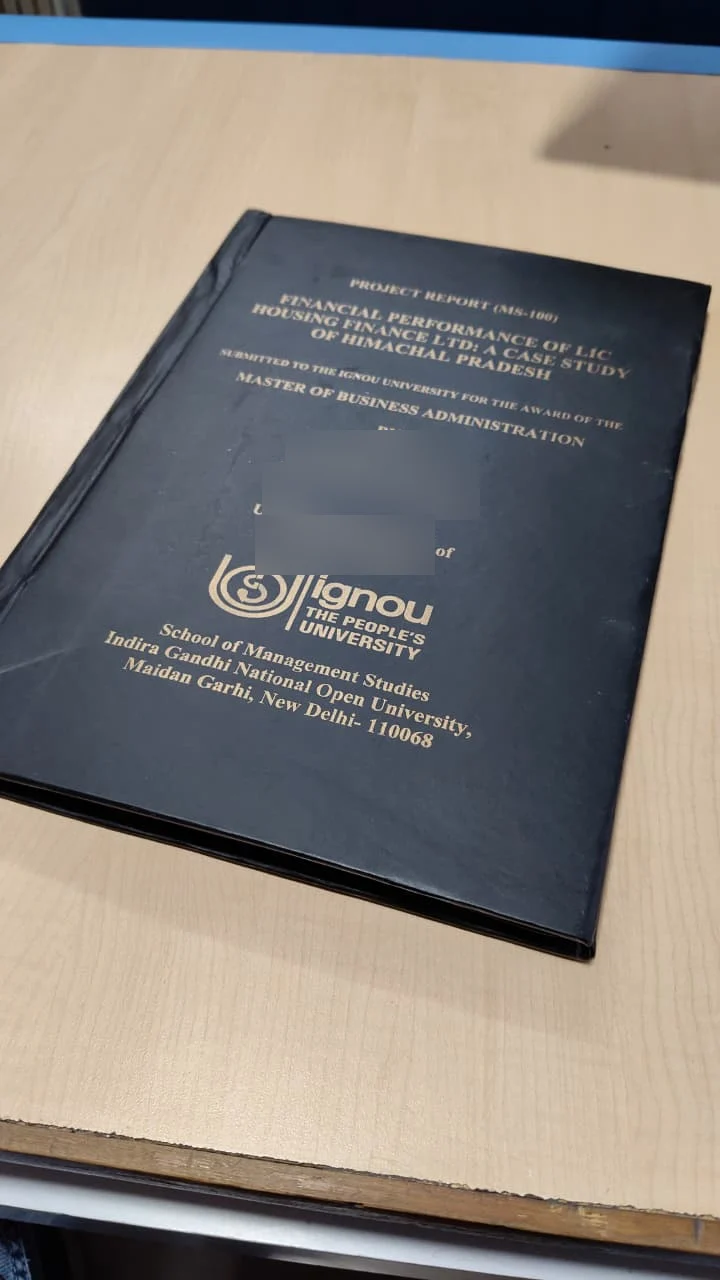
The IGNOU MBA project is one course, MMPP-001, worth eight credits. IGNOU counts it as two courses but registers it as one, and it sends no study material for it. Forms, receipts and search boxes print the same code as MMPP 001, MMPP 01 or MMPP 1; reports bound before the change carry the earlier code, MS-100. In the July 2026 Prospectus it sits in the third semester beside MMPC 015, Research Methodology for Management Decisions, the course whose methods the project puts to work.
Stage one is the synopsis, which the guidelines also call the project proposal. It travels with a proforma signed and dated by you and your guide and, unless your guide is an approved academic counsellor, the guide's bio-data signed in original. It goes to the Regional Director of your Regional Centre, by post or to the Centre's email; MBA (Online) learners send it through the LMS portal. Stage two begins only when a written approval arrives. The report then goes to the Student Evaluation Division (SED) at Maidan Garhi, or is uploaded as PDF files when IGNOU runs its online route, as it does for December 2026.
What decides the report is the evidence. Most of the six method items the synopsis must cover are about data: where it comes from, who supplies it, how it is collected and which statistics turn it into findings. The report adds the reliability and validity of your tools, then asks for results in tables or graphs with an elaborate interpretation. This homepage is built around that part. For the guidelines in sequence and topic directions, our MMPP-1 guidelines and topics page covers the route.
Project course by programme. MMPP-001 rows from the MMPP-001 guidelines; the other four from the Common Prospectus, July 2026.
Programme
Project course
Where the synopsis and report go
MBA, MBAFM, MBAHM, MBAMM, MBAOM, MBF (ODL)
MMPP-001, 8 credits
Synopsis to your Regional Director; report to the Registrar (SED), Maidan Garhi, or OPMS when notified
MBA (Online)
MMPP-001, 8 credits
Both through the LMS portal
MBACN (construction management)
MMPNP 001, 8 credits (p. 132)
Its own School's project guidance
MBALS (logistics and supply chain management)
MMPLP 001, 8 credits (p. 133)
Its own School's project guidance
MBAABM (agribusiness)
MAMP 060 Project Work, 8 credits (p. 139)
Its own School's project guidance
MBAHCHM (health care and hospital management)
MHHP 021 Project, 6 credits (p. 140)
Its own School's project guidance
Six Method Items in the Synopsis and What the Report Adds
Step 3 of the IGNOU MBA project guidelines lists five parts for the synopsis: introduction, rationale, objectives, research methodology and limitations. Under research methodology it names six items. The methodology chapter of the report repeats them and adds the line that many drafts leave out, the reliability and validity of the tools used. The table pairs each synopsis item with what the report must later say about it.
Wording from Step 3 (iv) and the report structure, section 2 (ii), of the MMPP-001 guidelines; the last column points to the part of this page that works it out.
Synopsis method item
What the report's methodology must state
Worked out here
1. Research design
Research design
Three kinds of evidence
2. Nature and source of data or information to be collected
Nature and source of data or information collected
Data by specialisation
3. Sample and sampling technique; rationale of the chosen organisation and the sample
Sample and sampling method, with rationale
Sample and sampling
4. Tools and techniques for data collection: details of the tools or questionnaire and its relevance with the objectives
The questionnaire and other methods used, and their purpose; reliability and validity of the tools used
Questionnaire; reliability and validity
5. Method or methods to be used for data collection
Data collection
Questionnaire, pilot, annexure
6. Data handling and analysis: organisation and analysis of data, statistical tools, and their relevance with the objectives
Statistical tools used for data analysis; results in tables or graphs, interpreted
Objectives; results and discussion
Two of the six items carry the words "relevance with the objectives of the project". That phrase is what the evaluator tests: every objective should point to a source, a tool and a statistic, and every question in the questionnaire should point back to an objective. The objective-to-analysis check among the free tools near the top of this page does exactly that pairing with what you type.
Case Study, Inter-Organisational or Field Study: Three Kinds of Evidence
The IGNOU MBA project guidelines allow three kinds of project. The choice is more than a word on the title page. It decides where your evidence comes from, and which of the six method items will carry the most weight when the evaluator reads the synopsis.
The first two columns are from section 1 of the MMPP-001 guidelines; the last two are our reading.
Type, as printed
What it covers
Evidence it usually rests on
Method items to write most carefully
Comprehensive case study
A single organisation or a multifunctional area problem: formulation, analysis and recommendations
The organisation's records and reports, interviews with its managers, sometimes a staff questionnaire
Rationale of the chosen organisation; nature and source of data; written permission to use records
Inter-organisational study
Comparison between organisations, validation of theory, or a survey of management practices
The same measure taken in each organisation, from records or from one common questionnaire
Sample and sampling with a rationale for each organisation; the statistic used to compare
Field study (empirical study)
Data gathered in the field
Your own questionnaire or interview schedule, answered by a defined group of respondents
Sample size and technique; questionnaire and its relevance; reliability and validity
The guidelines print no topic list for MMPP-001. They ask that the topic come preferably from your area of specialisation and that the title be definitive, conveying the subject matter covered. A working title such as "Influence of delivery time on repeat purchase among quick-commerce customers in Lucknow" passes that test because it names the variable, the people and the place, and it tells you at once that this is a field study needing a questionnaire.
IGNOU MBA Project Data by Specialisation
IGNOU MBA project data analysis starts with the subject area you write on the proforma: HRM and OB, Accounting and Finance, Operations Management and Information System, Marketing, Corporate Management, or Any Other. The guidelines want the topic preferably from your specialisation and advise a guide who is a specialist in that area, so the data you plan should belong to the same field. The table shows what that usually means in practice, including where primary data for IGNOU MBA project work comes from and which public datasets can stand in as secondary sources.
Our suggestion, not an IGNOU list. The dataset names are real public sources; check their coverage and dates when you plan.
Subject area on the proforma
Variables often measured
Primary data
Public secondary sources
Analysis often used
HRM and OB (MBAHM)
Engagement, job satisfaction, training effectiveness, intention to leave
Employee questionnaire; interviews with HR staff
Periodic Labour Force Survey (MoSPI) for labour-market context; company HR policy documents with permission
Percentages, weighted mean, cross-tabulation with chi-square, correlation
Accounting and Finance (MBAFM)
Liquidity, profitability, leverage, working capital, payout
Rarely needed; short interviews with finance staff
Annual reports and stock exchange filings (NSE, BSE); RBI Database on Indian Economy
Ratio and trend analysis, growth rates, comparison of means across firms
Operations Management and Information System (MBAOM)
Lead time, inventory turnover, defect rate, system adoption
Observation, process logs, staff questionnaire
The organisation's own records, used with written permission
The guidelines call the objectives the most important aspect of the project. They should state clearly and precisely what you hope to know at the end of the study, may be stated in behavioural terms, and must be neutral, carrying no implicit assumption about the findings. IGNOU's own sample begins four objectives with To study, To explore, To analyse and To investigate.
A practical test for an IGNOU MBA project objective: can you name the table in your results chapter that will answer it? If you cannot, the objective is too wide, or the data you can reach cannot measure it.
Our pairing of IGNOU's sample stems with common data and statistics. IGNOU prescribes no statistic for MMPP-001.
Objective as written
Data it needs
Statistic
Table in the results chapter
To study the level of work engagement among employees
Responses to a multi-item scale
Percentages, weighted mean per item and scale
Frequency table per statement with mean
To explore the relationship between perceived flexibility and engagement
Two measured variables from the same respondents
Correlation (Pearson or Spearman)
Correlation matrix with n and significance
To analyse the factors affecting repeat purchase
Ratings of several factors
Mean ranking; regression if the sample allows it
Ranked table of factors
To investigate the influence of age on digital payment use
A grouping variable and a usage variable
Cross-tabulation with chi-square
Cross table with row percentages
To study the financial performance of a company over five years
Figures from annual reports
Ratio and trend analysis
Year-wise ratio table
A before-and-after pair shows the neutral rule at work. "To prove that hybrid work improves engagement" assumes the answer. "To study the relationship between perceived flexibility of hybrid work and work engagement among employees" leaves the answer to the data, and it already names the correlation table that will carry it.
The Questionnaire, the Pilot and the Annexure
In a field study the questionnaire is the instrument the whole IGNOU MBA project rests on. The guidelines ask for details of the tools or questionnaire and their relevance with the objectives in the synopsis, then for the questionnaire and its purpose in the report's methodology, and they list the questionnaire used among the annexures. Six steps keep it defensible.
Map items to objectives. Give each objective its own block of questions and record every item in the codebook sheet of our kit, so that no question exists without a reason.
Use an established scale where one exists. Our sample synopsis takes the nine-item Utrecht Work Engagement Scale rather than inventing engagement questions. Cite the scale's source and check its terms of use; the UWES authors allow non-commercial academic use.
Keep one response format per block, for example five points from strongly agree to strongly disagree, and mark any negatively worded item so it can be reverse-coded later.
Open with a short consent line and keep only the background questions you will actually analyse.
Pilot it with a small group outside your final sample, note every change in the pilot log, and keep the pilot answers for your reliability test.
Put one blank copy in the annexures of the report.
The data codebook kit holds the sheets for steps 1, 3 and 5: variable, question, code, scale and missing-value columns, Likert and multiple-choice coding rules, an entry layout and a pilot log.
Sample and Sampling: the Rationale MMPP-001 Asks For
The third method item asks for three things, and most drafts give only one: the sample, the sampling technique, and the rationale of the chosen organisation and the sample. The rationale is a short argument. Why this organisation, why these respondents, and why this number, written so that an evaluator who has never visited your city can follow it.
Standard textbook techniques; IGNOU names none for MMPP-001.
Technique
When it fits an MBA project
What to write in the rationale
Simple random
A full list of the population exists and you may use it, such as an employee roster
Where the list came from and how names were drawn
Stratified
Groups differ in ways that matter, such as departments, branches or grades
The strata and how many from each
Systematic
A list exists and every kth name is taken
The interval and the random start
Convenience
No list exists, for example shoppers at a mall
The place, the days, and the limit this puts on generalising
Purposive
Only certain people can answer, such as branch managers
The criteria that made someone eligible
IGNOU sets no sample size for MMPP-001. When you estimate a proportion at 95 per cent confidence with a 5 per cent margin and the safest assumption of p = 0.5, Cochran's formula gives 384 respondents. When the whole population is small and known, apply the correction n = n0 / (1 + (n0-1) / N): for 400 employees across two firms it comes to about 196. Add an allowance for forms that come back incomplete, and say in the limitations what a convenience sample cannot claim.
Reliability and Validity: the Line Many MBA Reports Skip
Section 2 (ii) of the report structure asks for the reliability and validity of the tools used. It is one line in the guidelines and easy to leave out, yet it is where an evaluator learns whether your numbers can be trusted. Reliability asks whether the tool gives consistent results; validity asks whether it measures what you claim.
Common practice in management research; IGNOU prescribes no test or threshold for MMPP-001.
Evidence you used
Reliability line
Validity line
Multi-item Likert scale
Cronbach's alpha for each scale, with the number of items and responses; many textbooks treat 0.70 as acceptable for research use
An established scale cited to its source; content reviewed by your guide and tried in the pilot
Single questions and background items
Alpha does not apply; state that wording was kept the same for every respondent and tested in the pilot
Each question traced to an objective in the codebook
Interviews
The same schedule used in every interview; notes written up the same day
Respondents chosen because they hold the information, as stated in the sampling rationale
Annual reports and published data
The same accounting basis and definitions across all years used
An authoritative source, cross-checked against a second source where one exists
A sentence frame for the methodology chapter, to be completed with your own figures:
The reliability of the questionnaire was tested with Cronbach's alpha on [number] pilot responses and again on the final [number] responses. The [scale name] of [number] items returned an alpha of [value]. Content validity was reviewed by [guide or subject expert], and [number] items were reworded after the pilot.
Results and Discussion in an IGNOU MBA Project: Tables, Graphs, Interpretation
The guidelines ask that the results be presented in tabular or graphical format, with the interpretation of the data and the findings given elaborately. In an IGNOU MBA project report this is usually the longest chapter; our template budgets about 7,500 of the 18,000 words for it. Six habits make the tables readable:
Number tables by chapter (Table 3.1, Table 3.2) and list them after the contents page.
Give each table a title that says what was measured and among whom, and show n.
Add a source line under each table, for example "Source: primary data, field survey, month and year".
Show percentages to one decimal place and make sure each row adds to the total.
Keep one idea per table; a cross-tabulation earns its place when it answers an objective.
Use a graph only when it shows something the table does not.
Under every table, write the interpretation in four moves: what the table shows, the one figure that matters most, what it means for the objective, and how it agrees or disagrees with the studies in your literature review. Close the chapter with a short section on what the data could not show.
For the arithmetic of a single five-point statement, use the Likert statement summariser among the free tools; you still write the reading under each table yourself.
Conclusions, Recommendations and References That Follow the Data
After the results, the report structure in the guidelines runs: summary and conclusion, recommendations, limitations of the project with directions for further research (optional), references or bibliography, and annexures. Each part has one job in an IGNOU MBA project report.
Summary and conclusion: restate each objective and give the finding that answers it, with the table number. Nothing new enters here.
Recommendations: one per finding that needs action, saying who should act and how. A recommendation with no finding behind it is opinion.
Limitations: the sample, the place, the period and the tools, stated plainly. An honest limitation reads better than an unsupported claim.
References: MMPP-001 sets no style, so choose one consistent format (APA is common in management research), list every source cited in the text, and give the date you accessed online data.
The Proforma, Box by Box
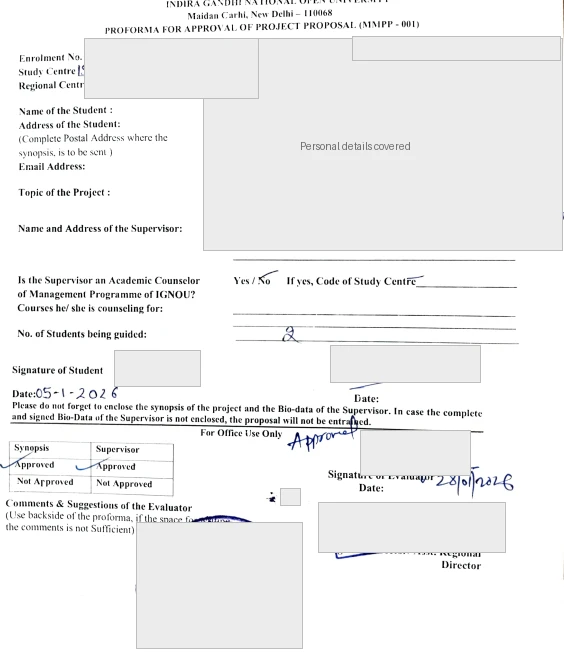
The Proforma for Approval of Project Proposal (MMPP-001) is the last page of the guidelines file. It travels with the synopsis of your IGNOU MBA project, signed and dated by you and your guide, and comes back carrying the evaluator's decision. The third column shows where each box has to agree with your method section, because an evaluator reads the two together.
Boxes and instructions from the MMPP-001 proforma and its filling instructions; the third column is our cross-check.
Box
What goes in it
What it must agree with
Enrolment No.
The number IGNOU gave you. If the four-year maximum is over, seek re-admission before sending; a synopsis approved on the old number must be approved again for the new one.
The cover page of the report and, for December 2026, the first page of the uploaded PDF
Project Proposal No.
Left blank: the Regional Centre assigns it on acceptance
Every later letter about approval
Study Centre
Your study centre
The counsellor's study centre code, if your guide is a counsellor
Regional Centre
Your own Regional Centre
The address on the envelope: its Regional Director
Subject Area
HRM and OB, Accounting and Finance, Operations Management and Information System, Marketing, Corporate Management, or Any Other (specify)
The variables and data in your method, and your guide's specialism
Name of the Student
Your name as on IGNOU records
The report cover
Address of the Student
The complete postal address where the reply should come
Where you will be for the next two to three months
Email Address
An address you check
Your Regional Centre correspondence
Topic of the Project
The final title, concise and clear
Your objectives and sample; once approved, the report must carry this title unchanged
Name and Address of the Supervisor
Preferably the official address
The guide's bio-data
Is the Supervisor an Academic Counselor of the Management Programme of IGNOU?
Yes or No; if yes, the code of the study centre
If yes, no bio-data is needed; if no, the signed bio-data must be enclosed
Courses he or she is counseling for
For counsellors, the courses counselled
The subject area of the topic
No. of Students being guided
How many MMPP-001 (earlier MS-100) students the guide supervises on that date
The limit of five at any given time
Signature of Student, Date
Your signature and the date
The date on the synopsis
Signature of Supervisor, Date
The guide's original signature and date
The signature on the bio-data
For Office Use Only
Left blank: Synopsis and Supervisor each marked Approved or Not Approved, the evaluator's signature, date and comments, and the countersignature of the Regional Director or Assistant Regional Director
The comments, which the report should answer
An approved Proforma for Approval of Project Proposal (MMPP-001). The student's and guide's details, signatures and stamps are covered; the subject area, the evaluator's ticks and the dates are left visible.
The guide's bio-data: five items the guidelines require
People search for an IGNOU guide biodata format PDF, but MMPP-001 prints no form for it. The guidelines list what the bio-data must state "in absolutely unambiguous manner", and they ask that it be signed in original by the guide, with the date. An approved academic counsellor needs none.
Name and date of birth of the guide.
Full address and contact numbers of the residence and the current workplace.
Detailed educational qualifications: degrees with specialisation, name and address of the university or institution, year of award and percentage of marks.
Detailed work experience in chronological order: designation, period, and the name and contactable address of each organisation.
Any other information relevant to assessing the guide's eligibility; a current business card may be attached.
Report Order and About 18,000 Words
The guidelines set the IGNOU MBA project report at about 50 to 60 double-spaced typed pages, not exceeding approximately 18,000 words, appendices and exhibits excluded, with rational variation either side permitted. They also fix what the final report must contain. The order below is the one our template follows.
Items and chapters from the MMPP-001 guidelines. The guidelines do not fix where the certificate and the bound proposal sit; this order is our template's, and the word split is our suggestion.
Order
Part
Rule or suggested words
1
Cover page
Name and enrolment number of the student, name of the guide, title of the project
2
Certificate of Originality
In IGNOU's wording, signed by the student and the guide, with dates
3
Approved proposal: project proposal, approved proforma and the guide's bio-data
Bound in the report, not stapled
4
Detailed table of contents
With page numbers; every page numbered as the contents show
5
Introduction and review of literature, with the organisation under study
About 3,500 words
6
Research methodology
About 2,500 words
7
Results and discussion
About 7,500 words
8
Summary and conclusion
About 2,200 words
9
Recommendations
About 1,600 words
10
Limitations and directions for further research (optional)
About 700 words
11
References or bibliography
Outside the word count
12
Annexures or appendices, including the questionnaire used
Outside the word count
Students often search for an IGNOU MBA project report when what they need is this order. Write to it from the first chapter and the 18,000 words take care of themselves; write freely and you will spend the last week cutting.
Bound Papers, Cover and Binding
When the report goes by post or by hand, the guidelines ask for one typed copy, A-4 size, double spaced, in a bound volume, sent by registered post, speed post or by hand to the Registrar (SED), IGNOU, Maidan Garhi, New Delhi 110068, with PROJECT REPORT-MMPP-001 written on top of the envelope. Before binding, the approved proforma, the approved proposal, the guide's bio-data and the signed originality certificate must be inside. A report without them is returned for compliance, a stapled proposal is not accepted, and the copy is not returned after evaluation, so keep one for yourself.
For the December 2026 Term-End Examination the route changes to uploads with no hard copy, as the next section explains. A bound copy then serves your own record. Our Dwarka press prints the hard copy free with a report correction; hard binding costs Rs 1,000, charged separately, and we take it up only after your approval letter and your guide's signed documents are in hand.
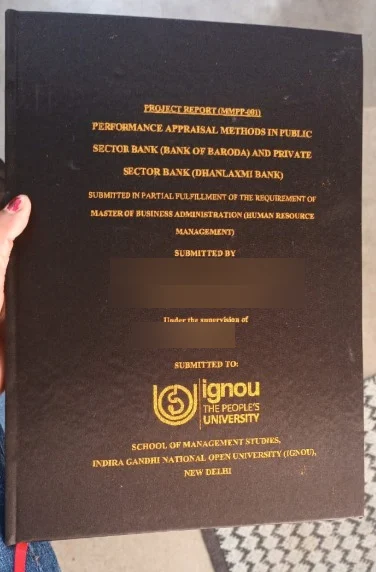
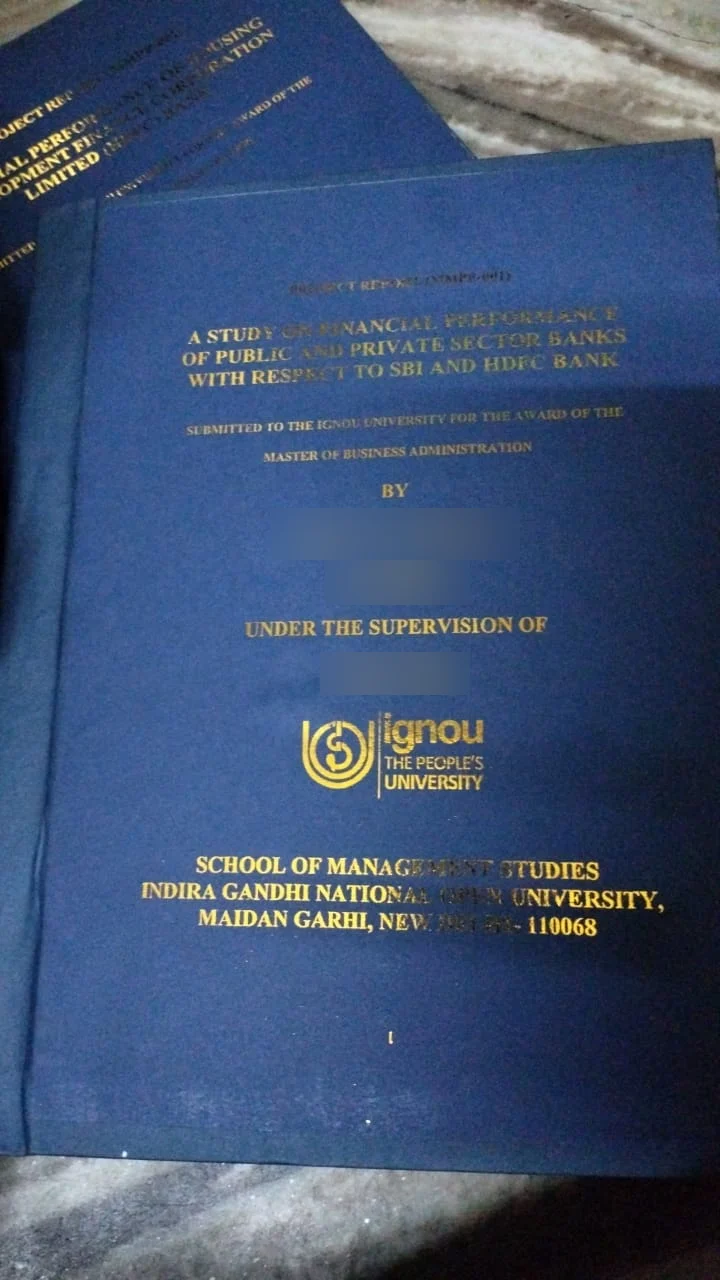
A hard-bound MMPP-001 report, blue cover.A hard-bound MMPP-001 report in HRM.An older report bound under the earlier code, MS-100, with names blurred.
December 2026: OPMS Upload, the Rs 500 Fee, Result Windows and the Viva
For the December 2026 Term-End Examination, IGNOU has moved project reports to its online project management system, OPMS. The rules below are from IGNOU's OPMS guidelines as we read them on 3 November 2026; open the portal yourself before you upload your IGNOU MBA project.
Pay the project fee on Samarth first; the upload comes after it.
Upload by 30 November 2026, 11:59 pm. The guidelines we read state no extension.
One PDF for each document: the report up to 40 MB, the guide's bio-data up to 5 MB, the approval letter up to 5 MB, and the proposal or synopsis up to 10 MB.
The first page of the report PDF shows the title, your name, programme code, enrolment number (not the control number), Regional Centre code and course code.
No hard copy is sent after uploading, and reports sent by email are not considered.
Any viva is held under your Regional Centre.
MMPP-001 has eight credits. The Prospectus (July 2026, p. 27) prints a project fee of Rs 300 for courses up to 4 credits and Rs 500 above, paid with the term-end examination form, and the guidelines note Rs 500 per course from the January 2023 admission cycle onwards. Outside the OPMS cycle a report can be submitted at any time of year, and the date decides the result window:
From section 3 of the report part of the MMPP-001 guidelines.
Report submitted between
Result declared with
1 December and 31 May
June Term-End Examination
1 June and 30 November
December Term-End Examination
Read those as result windows, not last dates. A viva-voce is held only if the evaluator recommends one, and you are told if so. For report status, write to the Assistant Registrar (SED), IGNOU, Maidan Garhi, New Delhi 110068, at projects@ignou.ac.in or 011-29571324 and 011-29571321, quoting the PR No. you receive on submission.
Before Your IGNOU MBA Project Leaves Your Desk
A last look at your IGNOU MBA project takes ten minutes and saves a return. Read the list for the stage you are at.
Synopsis envelope
All five parts, with all six method items
Objectives neutral, each with a source, tool and statistic
Proforma complete, signed and dated by you and your guide
Guide's bio-data signed in original, unless an approved counsellor
MMPP-001 written on the envelope, addressed to your Regional Director
A copy kept, and the receipt
Report file
The approved title, unchanged, on the cover with your name, enrolment number and guide
Reliability and validity stated for every tool
Every table numbered, titled and interpreted
Approved proposal, proforma and bio-data bound in; originality certificate signed by both
Questionnaire used, blank, in the annexures
For December 2026: fee paid on Samarth, PDFs within size, upload by 30 November
Everything on this page rests on one idea: in an IGNOU MBA project the evaluator reads your evidence, so plan it in the synopsis and show it in the report. When you want a second reader, the correction desk is a WhatsApp message away.
Who Runs This Desk: Company, Team, Press and Offices
ignoumbaproject.net is published by Shri Chakradhar Publication Pvt. Ltd. (CIN U22213DL2019PTC352185), a Delhi publisher of IGNOU study material and project guides. Our desk has worked with IGNOU students since 2010, and the company was incorporated in 2019. This IGNOU MBA project page is edited by our founder, BK Sahni, and checked against the IGNOU documents listed in its sources.
BK SahniFounder and editor
Anjali SharmaSenior manager
Kriti AroraSenior content writer
DeepshikhaSenior content writer
Certificates of Shri Chakradhar Publication Pvt. Ltd.
Head office and press, Dwarka
House No. 167, Ramphal Chowk Road, behind HDFC Bank, Harijan Basti, Palam Extension, Sector 7 Dwarka, New Delhi 110077
Team office, Tilak Nagar
1st floor, WZ-10A, Gali Number 6, Sant Garh, Shahpura, Chaukhandi, Tilak Nagar, New Delhi 110018
Is the IGNOU MBA project the same course for every MBA programme?
For MBA, MBAFM, MBAHM, MBAMM, MBAOM, MBF and MBA (Online), yes: it is MMPP-001. Four other MBA programmes carry their own project codes in the July 2026 Prospectus: MBACN has MMPNP 001, MBALS has MMPLP 001, MBAABM has MAMP 060 and MBAHCHM has MHHP 021. Their Schools' guidance applies to them.
Is there a last date for the MMPP-001 synopsis?
The guidelines let you send the synopsis throughout the year after you register for MMPP-001. They warn that a proposal reaching the Regional Centre more than six months after registration may miss timely disposal. The 30 November 2026 date is the OPMS upload date for reports in the December 2026 cycle, not a synopsis date.
Can I send the synopsis and the report together?
No. Project work may begin only after a written approval of the synopsis is received. The synopsis goes to your Regional Director; the report goes later to SED, or to OPMS for December 2026.
Does an approved counsellor guide need to send bio-data?
No. The guidelines ask for the guide's signed bio-data with the synopsis, but not when the guide is an approved academic counsellor of the Management Programme. The proforma then asks for the study centre code and the courses counselled.
Where can I get an IGNOU MBA synopsis sample?
Our free sample synopsis is linked above, with a report format template and a data codebook kit. They are study reference only. Use them for structure and method, and build your own topic, organisation, sample and data.
Can my project use secondary data only?
The guidelines ask you to state the nature and source of your data and do not forbid secondary data. A case study of one company's annual reports can rest on it. A field study, described as an empirical study, is one where you gather the data yourself.
How long should the report be?
About 50 to 60 double-spaced typed pages, not exceeding approximately 18,000 words, with appendices and exhibits excluded. The guidelines permit rational variation on either side.
Is a viva compulsory for MMPP-001?
Not as a rule. A student may be asked to appear for a viva-voce if the evaluator recommends it, and is informed in that case. For December 2026 the OPMS guidelines place any viva under the Regional Centre.
What do I send if my synopsis is not approved?
A revised proposal with a fresh proforma, plus a copy of the rejected proposal and proforma bearing the evaluator's comments and the PP No. the Regional Centre allotted. If the guide changes, it counts as a new proposal with the new guide's signature.
Which referencing style does MMPP-001 require?
None is named. Choose one consistent format, such as APA, and apply it to every in-text citation and every entry in the reference list.
More MBA Help on This Site
This homepage covers samples, method and results for the IGNOU MBA project. The rest of the MMPP-001 route, and help for the other MBA courses, sits on these pages.
IGNOU, School of Management Studies. MMPP-001 Project Course: Guidelines for Submission of Synopsis and Project Report, with the Proforma for Approval of Project Proposal. ignou.ac.in. Read in full, November 2026.
IGNOU. Common Prospectus, July 2026: p. 27 (project fee slabs), p. 32 (MBA fees), pp. 131 to 140 (MBA, MBACN, MBALS, MBAABM and MBAHCHM programme tables). Read November 2026.
IGNOU, Student Evaluation Division. OPMS guidelines for project submission, December 2026 Term-End Examination, opms.ignou.ac.in. Read 3 November 2026.
Sahni, BK (2026). Research Methodology for IGNOU MBA Projects (MMPP-001): Research Design, Objectives and Data Methods. Version 1.0. Zenodo. doi.org/10.5281/zenodo.20748477.
Cochran, W. G. (1977). Sampling Techniques (3rd ed.). New York: Wiley.
Cronbach, L. J. (1951). Coefficient alpha and the internal structure of tests. Psychometrika, 16(3), 297-334.
Nunnally, J. C. (1978). Psychometric Theory (2nd ed.). New York: McGraw-Hill.
Schaufeli, W. B., Bakker, A. B., and Salanova, M. (2006). The measurement of work engagement with a short questionnaire. Educational and Psychological Measurement, 66(4), 701-716.
The editor and publisher of this desk
BK Sahni founded Shri Chakradhar Publication Pvt. Ltd., which publishes IGNOU study material and project guides from Delhi. He edits this desk's pages, and his team's notes from MBA students appear in the boxes on this page.
This site, ignoumbaproject.net, is run by Shri Chakradhar Publication, which is not affiliated with, endorsed by or part of IGNOU. The rules quoted here are IGNOU's, from the documents listed in the sources; IGNOU's own notices prevail if they change. Our sample files are study reference only and must not be submitted.
Get help
Get help with your IGNOU MBA Project (MMPP-001)
Correction of the synopsis or report you wrote, analysis of the data you collected, printing and binding, all read against IGNOU's MMPP-001 guidelines. Tell us the service and your session (June or December), and we will share the price and the timeline.
 BK Sahni
 Anjali Sharma
 Kriti Arora
 Deepshikha
